

Video credits: The Ocean Race | Full Video on Youtube – Introducing: Offshore Team Germany | The Ocean Race


IMOCA 60 – “Einstein”
Offshore Team Germany
The Refit of ex-Acciona IMOCA60 – into “Einstein” – Offshore Team Germany took place at Trimarine’s Boatyard in 2018
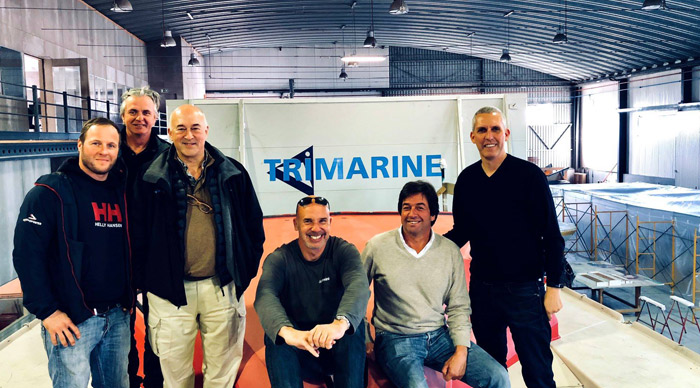
A challenging repair and total refit project, culminated with a first place at The Ocean Race Europe 2021.
“The build up of our campaign to the Ocean Race 2021/22 is supposed to be the starting signal for a new offshore sailing development in Germany. I immediately was enthusiastic about the idea of spreading the claim #madeingermany again through our participatian in The Ocean Race,” said Michael End, CEO of Offshore Team Germany.
On the morning of 3rd February 2013, while Acciona was negotiating the North Atlantic, its skipper triggered her distress beacons. Search and rescue teams sent to investigate found him in his life-raft and Acciona capsized, her keel broken.
The skipper was quickly rescued by helicopter, but Acciona spent several weeks in the ocean before being recovered. Her bruised and battered hull was then put in storage in Majorca, where it languished for five years.
For the repair of the hull, OTG selected Trimarine, the shipyard in Lisbon, Portugal, owned by Fernando Sena. For the design and engineering work, Kuphal turned to STRUCTeam of Cowes, UK, owing to the deep expertise of the team and its principal engineer, Frederic Louarn, who worked on Acciona in her first incarnation.
Sena and STRUCTeam have a working relationship that dates back to the formation of the consultancy in 2010. He says: “We speak the same language, engineering-wise.”
At Trimarine, Sena surveyed the scale of the damage to Acciona’s hull, which is made from thin skins of unidirectional (UD) carbon fibre-reinforced plastic (CFRP) prepreg, sandwiching a core made from panels of foam or Nomex, built around a canting keel. He says: “She was a well-constructed boat, but there were a few issues. Even though the yacht had been in storage for some time, the water had no way of evaporating. We had to get rid of all that water from the core before we could seal-off the laminates, which is difficult given that it is essentially invisible.”
Fortunately, Sena had a strategy to tackle the problem. He says: “First we removed the damaged skins strategically to ensure that we didn’t weaken the structure and maintained the shape of the boat. Some of the Nomex had to be removed because it was also damaged, but in other areas, we could apply a vacuum, the pressure of which lowers the evaporation point of water to almost room temperature.”
To aid their efforts, Sena used infrared (IR) cameras to locate any cold spots at the edges of the damage, which enabled his team to see where evaporation was occurring on the hull. When the spots warmed up, this meant that no evaporation was taking place and the team could be confident that they were dry.
Most of the repairs Sena and his team made were small, but there was an area of the hull of approximately two square metres in size where the skins on both sides – inside and out – had de-laminated completely and the core was totally destroyed. Repairing this damage was a delicate operation.
Sena says: “We need to make sure that the inner side of the hull was stable at all times before we removed the outer skin so that we did not lose its shape. We conducted some minor repairs on the inner skin to make sure that it was sealed, and then essentially built a mould to hold it in place so that we could then remove the outer skin and the core from the outside, chamfering it back. Then we vacuumed everything to remove all of the water, and once we were satisfied that everything was dry, we started bonding the core and applying the outer skin.” This work complete, the technicians removed the mould from the inside, took the inner skin off from the same place, and re-laminated it.
In August 2019, OTG launched its campaign for The Ocean Race 2022-23 with Acciona, now known as Einstein—20 years after a German team last entered and won the race. That same month, Einstein put in a promising performance in the Rolex Fastnet Race. Skippered by Robert Stanjek and navigator Conrad Colman, the yacht finished sixteenth out of field of 390. Even with the old sails and without foils, Einstein proved to be competitive and showed that a crew of five could sail an IMOCA 60 to its potential.


